A retail brand in Chicago wanted an app on iOS and Android. Their developer quoted two separate builds, an eighteen-month timeline, and a $40000 budget.
Then someone asked: What if one app ran on both?
That question is why hybrid development exists. In 2026, it is the starting point for most US app projects.
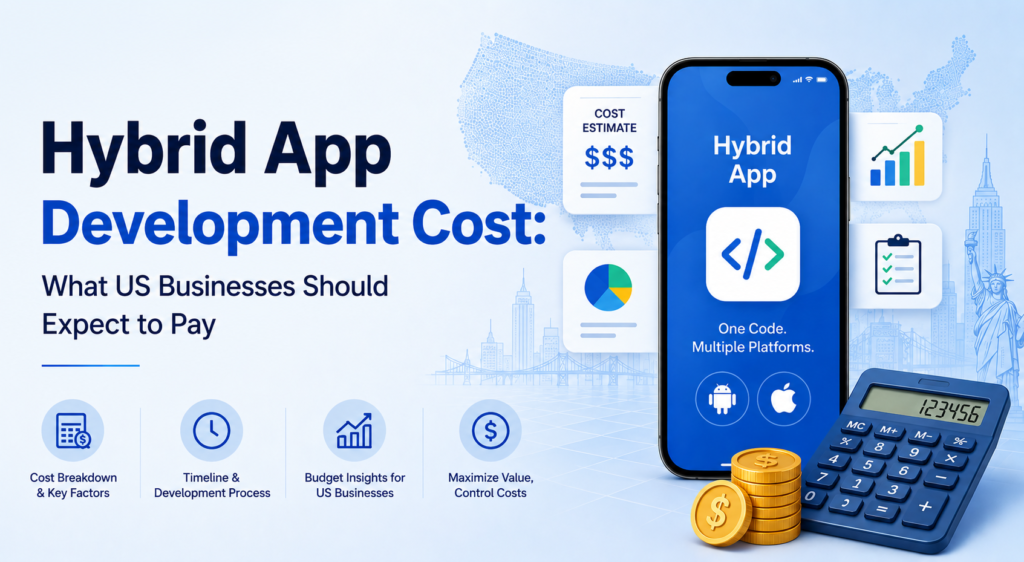
Hybrid app development cost typically runs from $15000 for a lean MVP to over $20000 for a complex enterprise platform. The range is wide, as the word hybrid covers everything from a simple customer portal to a real-time marketplace with deep integrations.
This guide explores what actually moves the number.
What Actually Pushes Hybrid Mobile App Development Cost Higher Than Expected?
Most founders budget for features. They forget everything underneath them.
The hybrid mobile app development cost is shaped by layers that never appear on a feature list.
Platform compatibility work is the most misunderstood expense. A single codebase runs on iOS and Android. Device behaviour is not identical. Camera permissions, push notifications, and file handling all need platform-based adjustments, even in the hybrid build.
Third-party integrations add cost fast. Payment gateways, CRM, connectors, and analytics platforms each required scoped engineering work. Underestimating this is one of the top reasons projects go over budget.
Security and compliance are non-negotiable for US businesses in the field of healthcare, fintech, and any sector that handles personal data. Compliance requirements add 15-25% to base development cost. It is important to plan it from the very first day.
What Type of App Shapes Your Hybrid App Cost Most?
The app category you are building is the strongest predictor of hybrid app cost. It is more than the framework, and more than the team size.
| Cost Ranges by App Type | |
|---|---|
| App Type | Estimated Cost (USD) |
| Informational or Brochure App | $10,000 to $20,000 |
| Customer Portal or Internal Tool | $20,000 to $50,000 |
| eCommerce App with Payments | $40,000 to $90,000 |
| On-Demand or Marketplace App | $60,000 to $150,000 |
| Enterprise Platform with Integrations | $100,000 to $250,000+ |
A brochure app is mostly static content: low complexity, short build. An ecommerce app adds payments, inventory, and notifications. Complexity rises sharply. A marketplace manages multiple user types and real-time logic. Timelines stretch past six months.
It is crucial to select a category before any developer quotes you a number.
How Long Does a Hybrid App Project Actually Take?
Timeline mismatches are where US businesses get burned most often. An agency quotes twelve weeks. The project ships at thirty. The gap is almost always about scope clarity at the start, not technical ability.
| Phase-by-Phase Breakdown | |
|---|---|
| Phase | Duration |
| Discovery and Architecture | 2 to 3 weeks |
| UI/UX Design | 3 to 5 weeks |
| Frontend Development | 5 to 10 weeks |
| Backend and API Integration | 6 to 12 weeks |
| QA and Device Testing | 3 to 5 weeks |
| Launch and Submission | 1 to 2 weeks |
Total for a mid-range hybrid app is 20-37 weeks.
QA is the most underestimated phase. Testing across dozens of Android variants and multiple iOS versions takes longer than most estimates allow. Build that buffer in from the very start.
Why Does Choosing a Hybrid App Development Company in the USA Change Everything?
The agency you hire is not a vendor. They are a co-author of your project.
A hybrid app development company in the USA that operates in your time zone, understands the US compliance requirements, and communicates in plain business language is worth more than a lower hourly rate from a team three continents away.
Before you sign anything, it is crucial to see a past project timeline alongside the original estimate. Ask how they handled what went wrong. Ask specifically about post-launch support. The answers will tell you everything.
Why Do US Businesses Choose Codeflicks Over Other Agencies?
Many US businesses hire an agency that promises everything, delivers something broken, and disappears when the bug shows up.
Codeflicks was built as the answer to that pattern.
Engineers, and not salespeople, found it. Every engagement starts with your business goals, not a rate card. With 150+ completed projects in the field of ecommerce, fintech, and healthcare, the team has seen nearly every category of hybrid app problem. Systems are made to scale, not just to launch.
If your hybrid app has already stalled, Codeflicks specializes in project rescue. The team audits your codebase, identifies every problem, and delivers a structured recovery plan before writing a single new line of code.
You get developers, designers, QA engineers, and project managers working as one coordinated team. Plain-language communication at every stage alongside a partner who treats your launch date as seriously as you do.
Get a free project assessment within 48 hours. Talk to Codeflicks today.
Frequently Asked Questions
What is the average hybrid app development cost for a US business in 2026?
Most US businesses spend $30000 to $150000 for a mid-range app. Simple apps can come in under $20000. Enterprise platforms regularly exceed $20000.
Is a hybrid always cheaper than building two native apps?
In most cases, yes. A single codebase saves 30-45% compared to separate iOS and Android builds.
How long does a typical hybrid app take to launch?
A focused MVP takes 4-6 months. Mid-range apps run 6-9 months. Enterprise projects can take 12 months or more.
What ongoing costs should US businesses expect after launch?
Budget 15-20% of your build cost annually for OS updates, security patches, hosting, and third-party API fees.
Can Codeflicks rescue a hybrid app project that has already failed?
Yes, the team diagnoses what went wrong and delivers a clear recovery plan before any new development begins.